Tech Support

TeachParentsTech is a great site – created by digital natives at Google, for digital immigrants (like me) in a fun, approachable,  and non-condescending way.

Explore the videos under each category that sound interesting.  They’re each about 2 minutes. They don’t answer questions with jargon.  Each of them ends with a picture of the narrator as a child (each one different!) with their parents.    Pretty darn cute.


Posted in Technology, Videos | Tagged , , , , , | 2 Comments

Batting – for Quilt Nerds

I did a trial batting wash and shrink test with some wool batting that I’d bought a while ago, which got me thinking that I’d never done the same on the batting that I normally use.  I mean of course I’ve washed quilts….But I’d never done a before and after measurement and done the math.

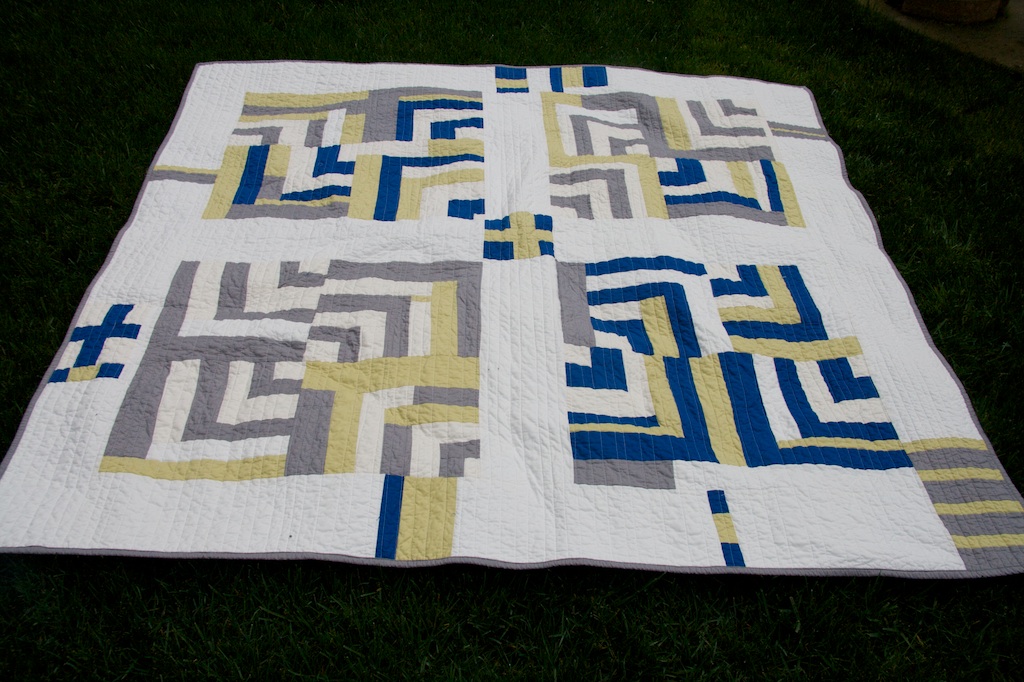
I finished the quilting and binding on the Improv quilt (I haven’t forgotten about Kaleidoscope Quilt) And I measured  and took pictures of a before and after wash/dry cycle.

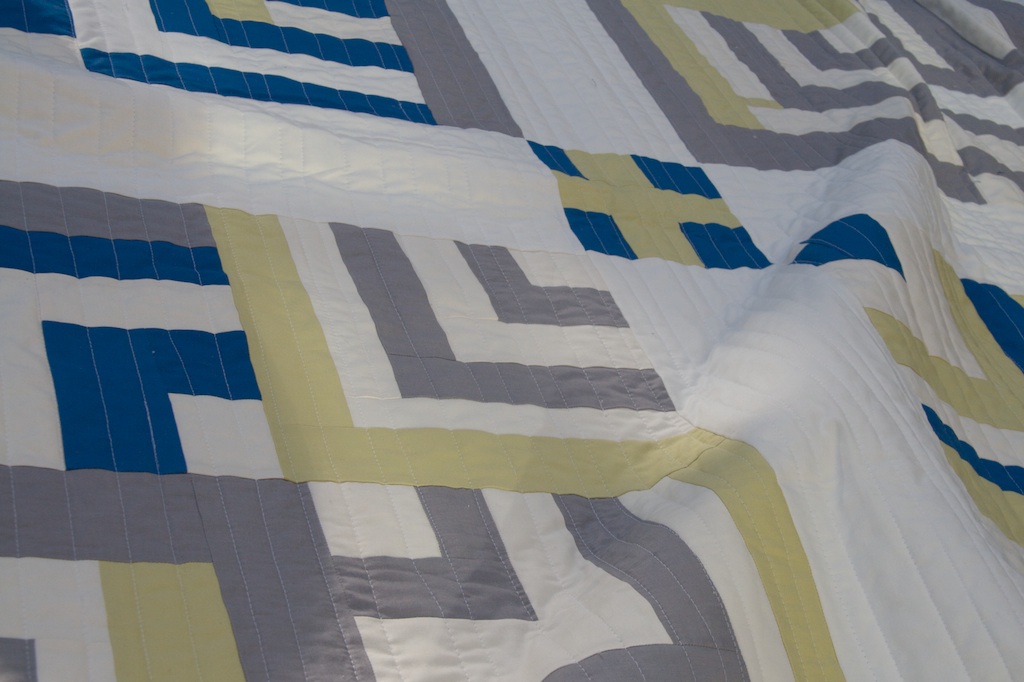
Here’s before:

I used:

  • Kona Cotton solids from Robert Kaufman on the top.  I did not pre-wash this fabric.
  • 100% cotton Warm and White Cotton Batting.
  • 100% cotton pre-shrunk and pieced flannel for the back. (In my experience flannel shrinks a whole lot after wash.  I highly recommend  prewashing any flannel before cutting and sewing)
  • Binding is Kona Cotton.
  • I used a cotton wrapped poly for quilting and channel quilted about 1″ apart on the straight grain of the batting.
  • I washed with a little Ecos detergent in a warm water wash and rinse.
  • And I dried the quilt on normal setting.

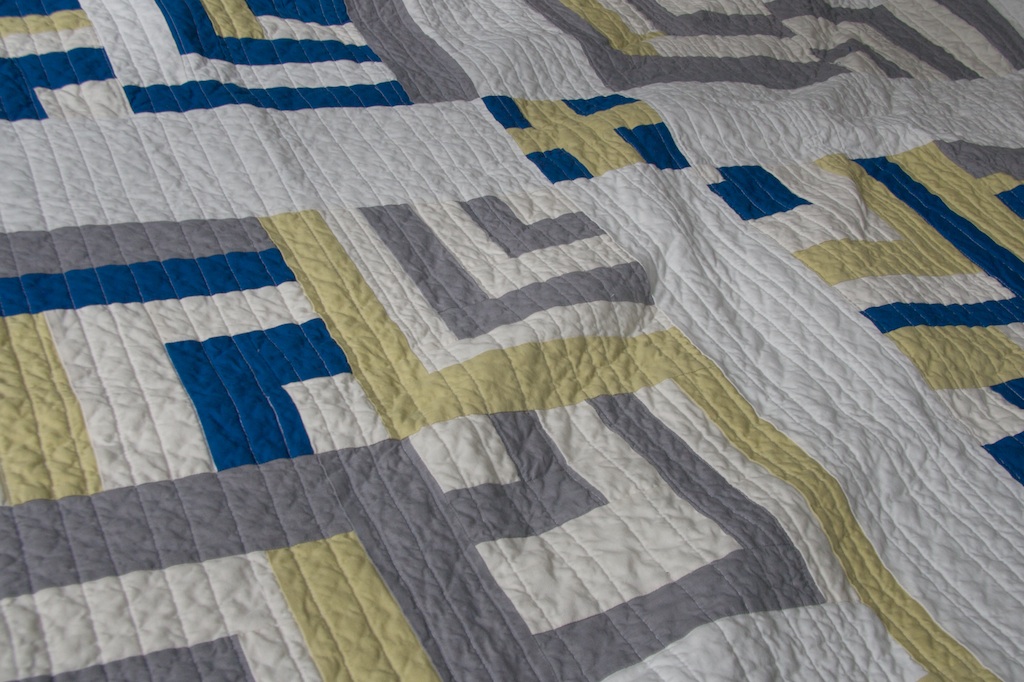
Here’s after:

My 70″x70″ before wash quilt became 68″x68″.  Shrinkage on the quilt was 2.9% both vertically and horizontally. This is a relatively good thing because if you’re like me and piece batting scraps together to make other bigger batting pieces, you don’t have to worry about straight grain and cross grain shrinkage differences with Warm and White.

If there’s a significant difference and if you’re not aware of grain, you could end up with parts of the quilt bunching up unevenly after wash. Incidentally,  the wool batting did shrink differently lengthwise vs. widthwise, so in that case,  that batting should not be patched together in different directions in a quilt you plan on washing.

Some of the Warm and White shrinkage may be attributable to the top fabric shrinking as well, but based on the pucker, my guess is that the shrink on the batting is higher.  The batting may well also continue to shrink more with successive washes, though usually shrinkage on things like this are highest on the first wash and dry.  This was one wash and dry cycle. 

Disclaimer:

I am not a fabric scientist.  I’m a fabric fan that maybe knows a little more about fabric than average.  My goal is to make things are not too delicate to drag around and then wash.  I’m not testing in a lab or controlled environment.  I’m using a tape measure and home laundry machines.  My assistant is a dog.

This blog/website cannot be held liable for quilts, fabric or batting that shrink more or less than stated here.

Posted in Quilts, Sewing, Uncategorized | Tagged , , , , | 6 Comments

Great Granola – A Recipe


We enjoy cereal here in the home office.  Pour it in a bowl, pour in some milk (or if you’re Humphry Slocombe, pour in bourbon), and there you have it – a meal.  Go crazy and add some fresh fruit and, voila, 3 food groups in a bowl with hardly any preparation.

Store bought granola doesn’t expire for about 6 months, by which time the nuts have gone stale, the oats don’t crunch right, and the fruit has gone hard. Homemade granola is worth the effort. It’s not a big effort. It’s one of the easiest things to make. This recipe makes quite a bit, but it gets consumed quickly if you’re like us and enjoy cereal.  I do not think I have had a batch last longer than 3 weeks here, max.  Make this and you won’t go back to buying it.

Ingredients

  • 6 Cups Rolled Oats (not the instant kind)
  • 1/2 C Flax Seed meal (or get whole flax seeds and cut them up in a clean coffee grinder or food processor)
  • 1/2 C Unsalted Unroasted Pumpkin Seeds
  • 1 C Sunflower Seeds
  • 1-1/2 C Slivered Almonds
  • 1 Teaspoon Cinnamon
  • 1/2 Teaspoon Ground Ginger
  • Chop roughly together (I chop mine in a Cuisinart )
    • 1 C Whole Raw Almonds,
    • 1-1/2 C Whole Pitted Dates
  • 3/4 C Olive Oil (If you like the taste of Olive Oil, use Extra Virgin, if not, you can substitute any less flavored vegetable oil)
  • 3/4 C Maple Syrup

What to do:

Mix all this together in a big bowl.  Divide the mixture between two large jelly roll pans lined with parchment or Silpat sheets.  Bake at 350 degrees Farenheit for 30 minutes taking the pans out to turn the mixture every 10 minutes to brown evenly.   Cool before storing. 

Substitutions:

If you don’t like something on this list other than oats (don’t bother making this if you don’t like oats), or you don’t have it, you can substitute other things, keeping in mind, that you want to come up with about 5-6 cups of dryish stuff to the proportion of the oats, oil and maple syrup.  So for instance, you could substitute, walnuts or pecans or other nuts for the almonds or seeds. Wheat germ could be sub’ed in for the flax seed.  Chopped apricots or raisins or other chopped dried fruit could be substituted for the dates. If you leave out fruit entirely, keep in mind that your granola might be less sweet.  That might be fine if you like that, or if you add fresh fruit to your granola to sweeten things up when eating.

The important thing to keep in mind while substituting is that some things stand up to baking longer than other things.  Things like raisins, dried cranberries or chopped dried apricots, for instance, should be added later in the baking/browning period than dates or they’ll get hard and weird.  And hard and weird is disconcerting in an otherwise great granola.

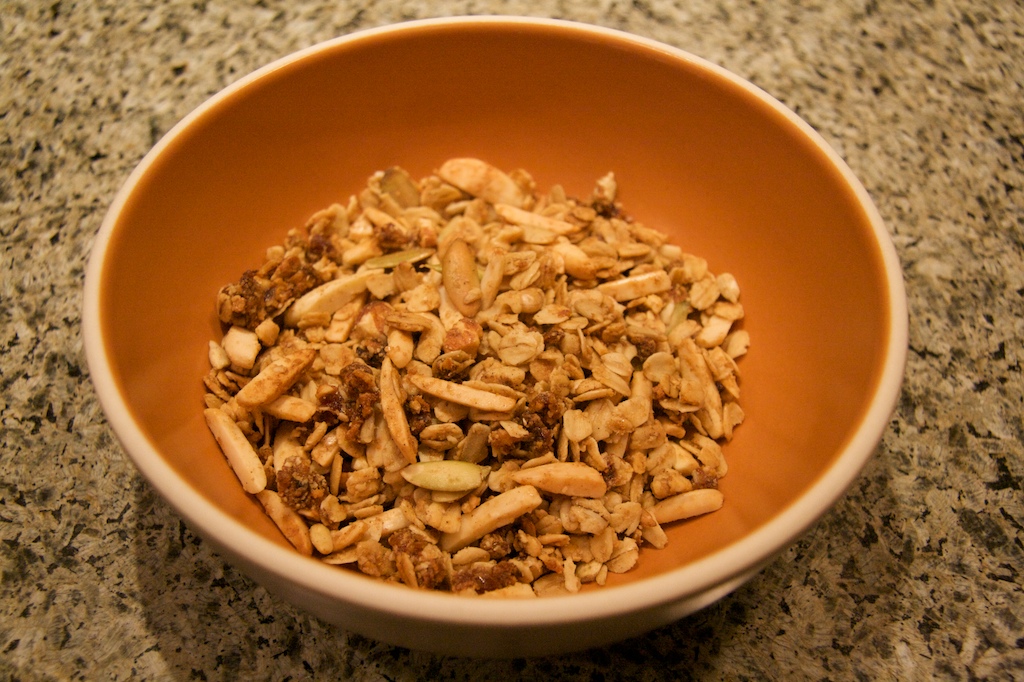
Great Granola

Posted in Food, Recipes | Tagged , , , | 4 Comments